




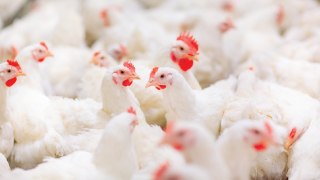
Costing the global poultry industry an estimated $17.5 billion annually, coccidiosis is one of the most costly diseases in the sector.1 To manage coccidiosis, you must first understand the disease’s life cycle. Understanding the disease allows you to act quickly and limit economic setbacks.
What is coccidiosis in poultry, and how does it impact birds?
Coccidiosis is a widespread, and highly contagious disease in poultry triggered by parasitic organisms from the genus Eimeria. It directly affects the intestines and can impact birds in different ways depending on the species of Eimeria involved.
Coccidiosis leads to significant economic loss in broiler production as it causes gastrointestinal disease damaging the lining of birds’ intestines, causing reduced nutrient absorption, diarrhea (which may be bloody in severe cases) and dehydration. As a result, it negatively affects feed conversation rate by up to 10%, weight gain by up to 7%, intestinal integrity and can potentially be fatal.1,2,3 As a result of the infection, birds will develop lesions in their gut, which can vary in location and severity based on the Eimeria species involved. It also weakens birds’ immune systems, making them more susceptible to secondary diseases.
The lifecycle of Coccidiosis
Coccidiosis is a cyclical disease as it involves stages of reproduction within the host, followed by the release of infectious agents into the environment, which can then infect new hosts. There are three primary stages that occur over a course of about 7 days including sporogony, merogony and gametogony.
1. Sporogony
The disease begins with sporogony, which is when the infected host passes Eimeria oocysts through their feces. If environmental conditions are adequate, the oocysts will begin to sporulate becoming infectious. This process usually takes one to two days, and requires optimal conditions of oxygen, temperature, and humidity.
Oxygen is a necessity as the oocysts cannot sporulate in anaerobic conditions.
Temperature is also a key factor as oocysts are sensitive to high or very low temperatures.
Finally, humidity is key as without moisture the oocysts will dry out leading to deformation of the oocyst wall.
If all environmental factors align, the oocysts will begin to sporulate becoming infectious if ingested.4
Once passed, the oocysts can contaminate areas such as feed, water, or litter posing a high risk of infecting the rest of the flock. Transmission of the disease occurs when other birds in the flock ingest the sporulated, infectious oocysts.4
2. Merogony (schizogony/agamogony)
Once the infectious oocysts are ingested, the merogony stage begins and takes place during days three and five. The digestive tract of the bird alters the structure and permeability of the oocyst wall. The sporozoites contained within the oocysts are released into the intestinal lumen of the bird where they disrupt intercellular junctions and weaken the gut barrier. Shortly after, asexual reproduction takes place releasing merozoites within the host. The primary focus of this stage is to increase the number of merozoites within the host in preparation for sexual reproduction in the next stage.4
3. Gametogony
Once the asexual reproduction is complete, the final stage, gametogony, begins. This stage entails sexual reproduction, which occurs in three events, and typically lasts between days five and seven. The first event is gametocytogenesis, which is when gametocytes are produced from merozoites. Second, during gametogenesis, micro and macrogametes are separated from the gametocytes. The final stage of sexual reproduction is when macrogametocytes are fertilized by microgametocytes creating the oocyst. The oocysts are protected by a double wall of proteins and fats that provide resistance to mechanical and chemical damage from the environment.4
The oocyst is eventually excreted from the bird in feces, which is where the reoccurring lifecycle of coccidiosis begins with sporogony, as mentioned above.
Managing Coccidiosis
Understanding the lifecycle of coccidiosis is key to properly managing the disease with guided control strategies. The most common form of treatment is with anticoccidials, which is administered to inhibit or kill Eimeria parasites. Anticoccidials must align with the parasite's lifecycle to effectively combat the parasites. Since most intestinal damage occurs before clinical signs appear, early intervention is critical when treating coccidiosis.
Alternatively, vaccination with a low dose of weakened oocysts can allow birds to develop immunity. However, it is important to note that this type of vaccination is species-specific, meaning any other species of Eimeria not included in the vaccination still poses a risk for infection.
It is best to closely monitor your flock for signs of coccidiosis including lesion scores, and oocyst counts to identify high-risk periods and Eimeria species. Intervention should always be based on flock type, age and what type of Eimeria species are prevalent in your area. To best avoid infections, make sure biosecurity is a top priority. Most importantly, keep your flock's area clean by practicing good litter management to avoid transmission of coccidiosis or other types of infections.
Elanco and the diagonal bar are trademarks of Elanco or its affiliates.
Tags
Coccidiosis
1Blake, D., Knox, J., et al. 2020. “Re-calculating the cost of coccidiosis in chickens.” Veterinary Research. https://veterinaryresearch.biomedcentral.com/articles/10.1186/s13567-020-00837-2#citeas
2Marusich, W., Ogrinz, E., et al. 1972. “Effect of coccidiosis on pigmentation in broilers.” Br. Poultry. Sci. https://pubmed.ncbi.nlm.nih.gov/4638818/
3Graham, D., Petrone-Garcia, V.M., et al. 2023. “Assessing the effects of a mixed Eimeria spp. challenge on performance, intestinal integrity, and the gut microbiome of broiler chickens.” Frontiers in Veterinary Science. https://doi.org/10.3389/fvets.2023.1224647
4Mesa-Pineda, C., Navarro-Ruíz, J., et al. 2021. “Chicken Coccidiosis: From the Parasite Lifecycle to Control of the Disease.” Frontiers in Veterinary Science. https://pmc.ncbi.nlm.nih.gov/articles/PMC8724208/