




From Miami to Cattle Country:
How One Ph.D. Researcher is Bridging the Gap Between Animal Welfare and Sustainability
From Miami to Cattle Country:
How One Ph.D. Researcher is Bridging the Gap Between Animal Welfare and Sustainability
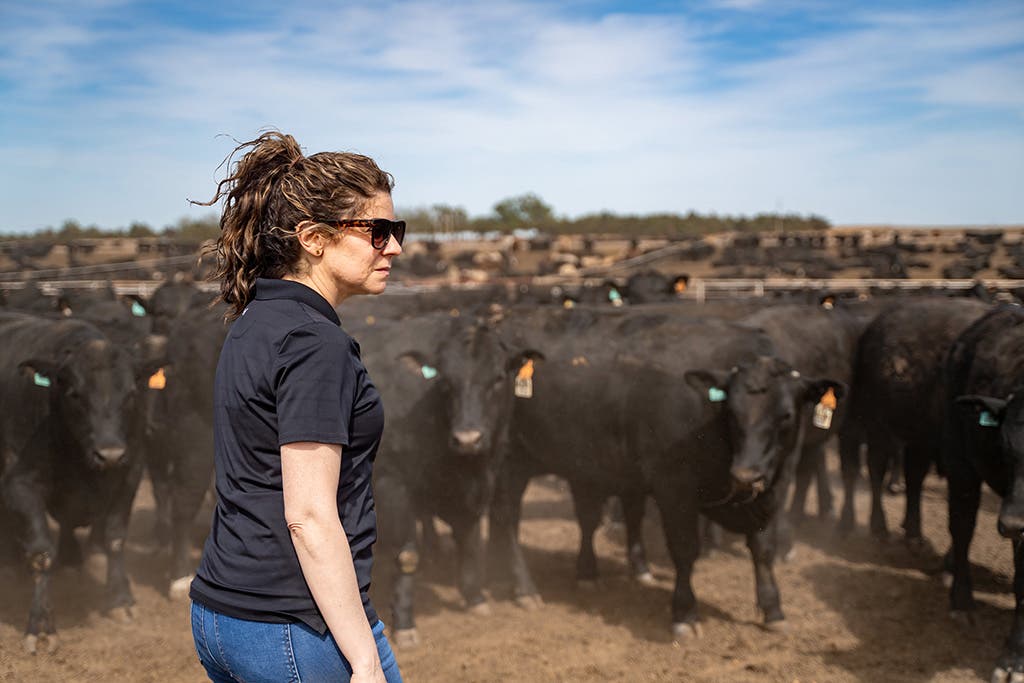
Growing up, if anyone had told Michelle Calvo-Lorenzo that one day she would be standing in the middle of a bustling cattle feedlot, she might have laughed. Raised in Miami with strong Peruvian roots, agriculture was a world unknown to her. Her early exposure to livestock came from activist campaigns on her college campus reflecting impassioned activist posters and edited photos, not from firsthand experience. She was a sun-loving city kid with a soft spot for stray cats and a love for every animal she met.
But life has a way of surprising people.
Michelle learned early to ask questions and care deeply about animals, people, and the world around her. At Florida International University, her curiosity blossomed. She saw the posters and heard persuasive narratives about how animals were raised and treated inhumanely. Yet a persistent voice inside wondered: Was she seeing the full picture?
This question never left her. So, instead of going straight to veterinary school as she originally planned, Michelle took a detour to earn a master’s degree at the University of California, Davis. She wanted answers. What was really happening on those farms? Were the stories about animal suffering the reality, or just a biased narrative in a much larger, more complex story?
Michelle traded the activist rhetoric for rubber boots, walking pens at dairies and calf ranches, asking questions, and learning from the ground up. She met people who cared fiercely for their animals, working through holidays and heat waves to keep them healthy. She witnessed firsthand the delicate balance of science, ethics, and economics that defines modern agriculture.
Then, as she advanced her education to earning a Ph.D. at UC Davis, Michelle truly fell in love with animal welfare science. She began to ask: “What do the animals show us? How do they behave, cope, and thrive?” These questions – rooted in evidence and empathy – set her on a path to bridge the gap between science and society that, like her at one time, is largely removed from the realities for agriculture.
Studying Animal Welfare on the Cutting Edge
In 2015, Michelle’s journey led her to Elanco Animal Health, where she now serves as Chief Animal Welfare Officer. She leads research, shapes strategy, and ensures that animal welfare is central to the organization’s mission. Michelle works with farmers, veterinarians, nutritionists and researchers across North America, helping them navigate new regulations, emerging technologies, and shifting consumer expectations.
One of her most exciting recent projects was a partnership with Colorado State University to study
Experior® (lubabegron) – the first product of its kind approved to reduce ammonia gas emissions in finishing cattle. A product that is good for the planet, but what about the animals?
Michelle and her team set out to answer this question with science, not speculation. They monitored cattle through hot summers, long transport journeys, and the stress of lairage before harvest. They measured heart rates, rumen pH, behaviors, lung and liver health, and, crucially, mobility using a scoring system that is extensively used in cattle welfare research and commercial monitoring services. Their goal: to ensure that sustainability wasn’t achieved at the expense of animal welfare.
The results were compelling. Cattle fed Experior coped with stress as well as those without it in their rations. Their breathing patterns, heart rates, and rumen functions were consistent with that of other cattle on the study. They handled weather conditions and transport stress with resilience. Most importantly, there was no increase in health or mobility problems – a vital finding for both the animals and those who care for them1.
Progress with Purpose: Advancing Welfare and Sustainability
For Michelle, this work represents both the current state and future vision of animal agriculture: a world where welfare and sustainability continue to advance hand-in-hand. After years in the field, she knows that sick, stressed animals aren’t just an ethical concern; they are also an environmental and economic one. Such animals require more resources, are likely to emit more gases, and if not properly cared for, will fail to thrive. In contrast, healthy, comfortable animals are calmer and safer to care for, resulting in more efficiency, productivity, positive human-animal interactions and ultimately, more sustainable outcomes.
Michelle believes the greatest challenge and the greatest opportunity lies in staying one step ahead. The world is changing rapidly. Consumers demand food that is not only safe and affordable but also humanely produced and climate friendly. Every day, feedlot operators must balance expectations of increasing environmental stewardship, while managing a complex business. Experior creates the freedom and flexibility to do both. Additionally, Experior is a technology that meets today’s animal welfare expectations, while simultaneously offering a wide marketing window to fit the needs of the individual organization.
Michelle’s journey from Miami to the heart of cattle country has taught her that real change happens not in echo chambers, but when science, empathy, and tough questions come together. Today, she is proud to be a scientist working at the intersection of animal welfare and sustainability, helping to ensure that the industry is feeding the world…and doing it with heart.
Experior, Elanco and the diagonal bar logo are trademarks of Elanco or its affiliates.
The label contains complete use information, including cautions and warnings. Always read, understand and follow the label and use directions.
Important Safety Information:
Caution: Not approved for use in breeding animals because safety and effectiveness have not been evaluated in these animals. Do not allow horses or other equines access to feed containing Experior. A decrease in dry matter intake may be noticed in some animals
Indications for use:
For the reduction of ammonia gas emissions per pound of live weight and hot carcass weight in beef steers and heifers fed in confinement for slaughter during the last 14 to 91 days on feed. Based on existing information, reliable predictions of the reduction of ammonia gas emissions cannot be made on a herd, farm, or larger scale. Increased rate of weight gain, improved feed efficiency, and increased carcass leanness have not been demonstrated with this product.
Directions for Use: Feed 1.25 to 4.54 g/ton (1.39 to 5 ppm) of complete feed (90% dry matter basis) to provide 13-90 mg lubabegron/head/day continuously to beef steers and heifers fed in confinement for slaughter as sole ration during the last 14 to 91 days on feed.