



Bill D. Potter, PhD, MS, MBA
Dr. Potter earned an MS and PhD in Poultry Science from the University of Arkansas with an emphasis in Food Safety, as well as a BS in Animal Science and MBA from Texas A&M. His areas of expertise include poultry food safety, pathogen reduction, quality systems management, R&D, and continuous quality improvement.

Controlling Salmonella in poultry continues to be a serious concern for both consumers and poultry producers. Unfortunately, it can be difficult for poultry companies to implement strategies that provide consistent Salmonella control both on the farm and in the processing plant.
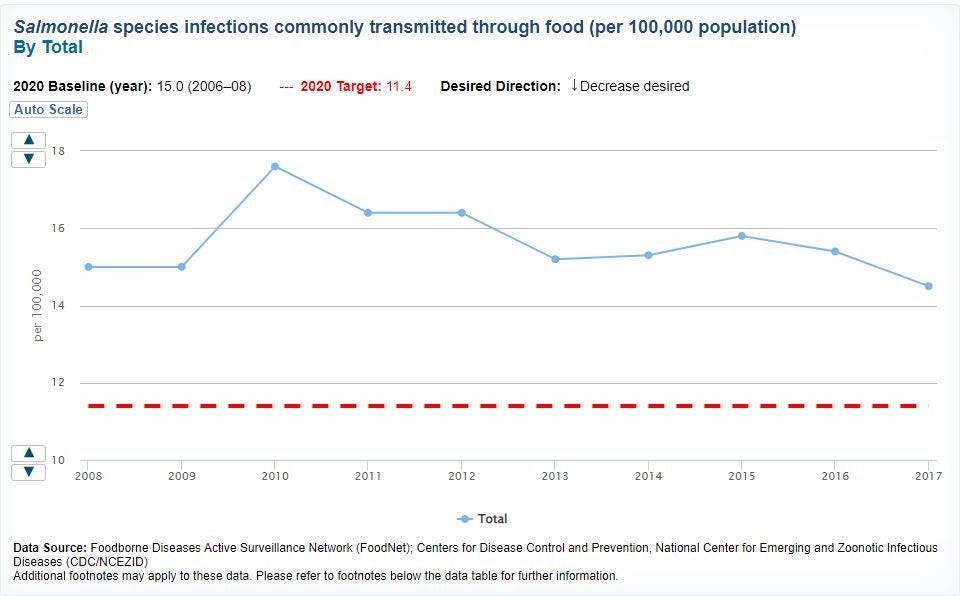
The graph below from the Healthy People Initiative¹ shows that Salmonella illness continues to be a major public health concern. These results continue to drive United States Department of Agriculture (USDA) efforts to reduce foodborne illnesses attributed to Salmonella in meat and poultry products.
An integrated farm-to-fork approach that addresses Salmonella interventions at all three phases of the food chain — live production, processing and retail distribution — is the most effective way to consistently control Salmonella and protect consumer health.
In this article, we will be taking a look at how implementing pre-harvest interventions, including Salmonella vaccines in live production, can help integrated poultry producers reduce the load of Salmonella on incoming live birds and provide an opportunity to reassess their in-plant antimicrobial intervention program and optimize pathogen control across the entire farm-to-fork spectrum.
Salmonella Control Starts With Pre-Harvest Interventions
It takes a comprehensive pre-harvest program with a combination of interventions designed to maximize bird health and welfare and minimize poultry diseases, as well as foodborne pathogens, to help a bird achieve its full genetic potential and have an impact on reducing Salmonella contamination going into the plant. It’s important to follow best management practices for poultry houses, including water, feed and litter management as well as implement an effective bird health program. Maintaining comfortable temperature and humidity in the poultry environment during brooding and grow-out by providing adequate heating, cooling and ventilation are also essential first steps in foodborne pathogen control.
Implementing effective pest control and biosecurity programs is especially critical to the successful control of Salmonella contamination in poultry. Anything with legs can carry Salmonella — along with other unwanted bacteria and viruses — into a poultry flock. This includes people, insects and especially rodents. The implementation of a robust biosecurity program helps reduce the chance for Salmonella and other disease agents to enter a production site. Every producer should have a site-specific plan that includes criteria for implementing effective best management practices, as well as a regular pathogen monitoring and testing scheme designed to verify the effectiveness of the program.
In addition to adopting biosecurity management practices in live production, implementing Salmonella vaccination programs in pullet and broiler flocks play important roles in pathogen reduction. Vaccines enlist the bird’s own immune system in the fight against foodborne pathogens and are very effective in reducing colonization and shedding of Salmonella by live birds. Salmonella vaccines can be very effective in reducing Salmonella contamination in raw poultry products as well, and they should be considered a critical component of an integrated plant food safety strategy. Vaccines have many benefits on the farm:
- Vaccines stimulate early immunity and provide a competitive exclusion effect in the gut.2,3
- They reduce shedding of Salmonella organisms in the farm environment.4,5
- Vaccines reduce vertical Salmonella transmission from hen to chick.⁴
- Some vaccines can be specially designed to address serotypes of public health concern such as Salmonella Infantis⁶ or Salmonella Reading.⁷
Salmonella Vaccines Support In-Plant Interventions
Implementation of a Salmonella vaccination program often results in a reduction of the load or burden of Salmonella in birds delivered to the processing plant and can improve food safety in-plant intervention efficacy.
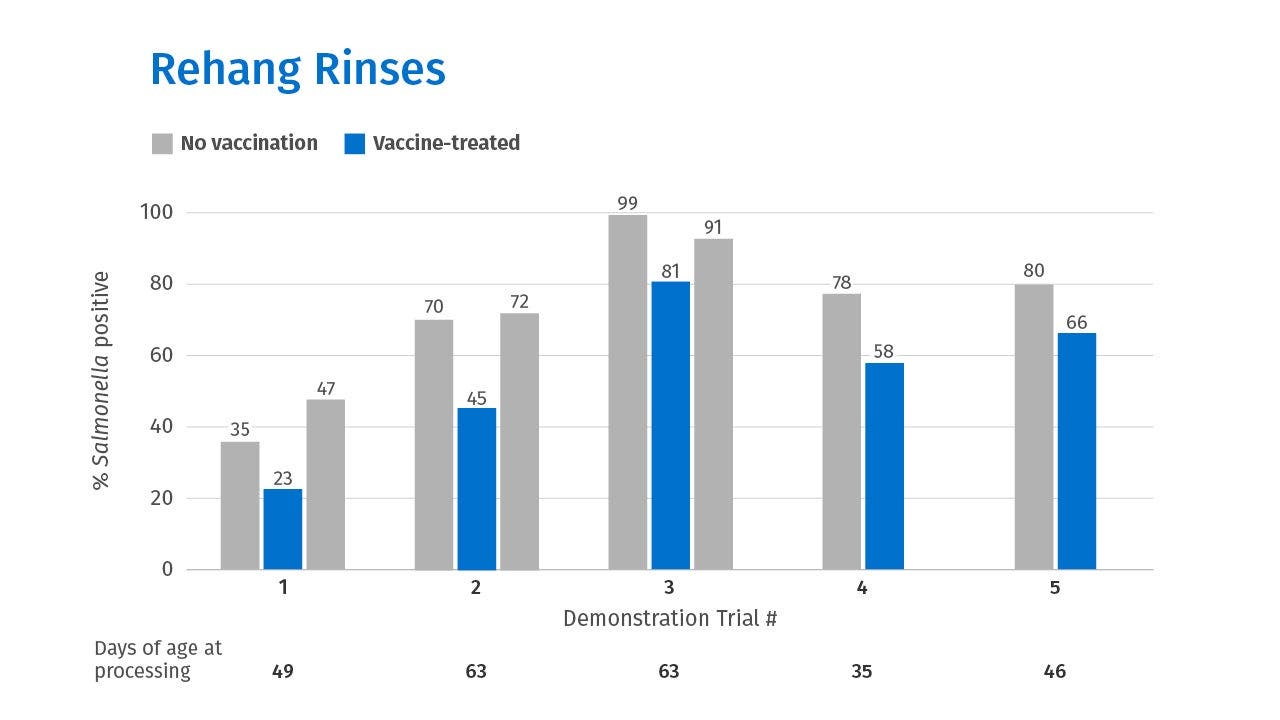
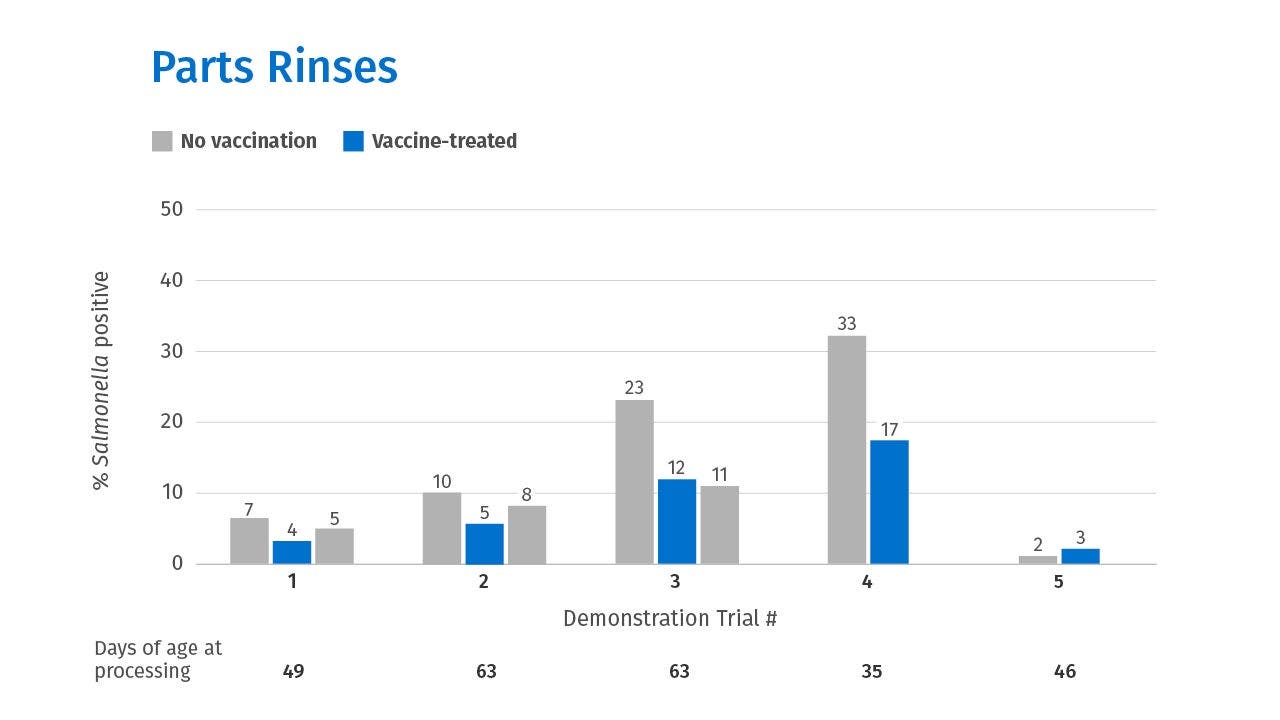
Between 2016 and 2019, Elanco worked with five integrated broiler companies to perform demonstration trials using two doses of the live Salmonella vaccine AviPro® Megan® Vac 1 and measured the prevalence of Salmonella positive samples pre- and post-processing. After the demonstration trials were complete at each company, the data sets were aggregated and compared.⁸ The reduction in Salmonella prevalence from pre-evisceration carcass rinses to parts rinses was consistently greater in vaccinated flocks than in non-vaccinated flocks. Also, there was an improvement in the efficacy of the in-plant Salmonella interventions as well.
The charts below demonstrated that:
- AviPro Megan Vac 1 was effective at reducing the load in vaccinated flocks delivered to the plant, as shown by the pre-evisceration hot-rehang carcass rinse results
- AviPro Megan Vac 1 was effective at reducing the Salmonella load in parts from vaccinated flocks, as shown by the parts rinsate results
The ROI of Salmonella Vaccines
It can be hard to quantify the value of reducing foodborne illnesses, achieving Category 1 status, preventing a recall or the peace of mind that an effective Salmonella intervention is being utilized. However, all these factors must be thought about when considering vaccines or other pre-harvest interventions.
It is not uncommon for a customer to ask about the ROI of pre-harvest interventions used in combination with in-plant antimicrobials. Plant-side pathogen control spend has increased significantly in recent years, and plant antimicrobials remain an important part of pathogen reduction strategies. Salmonella vaccines, like AviPro Megan Vac 1, provide benefits in two ways:
- Reduction of pathogen loads coming into the plant
- Improvement in the efficacy of the in-plant interventions, like antimicrobials
These benefits provide companies with an opportunity to rethink and reassess their farm-to-fork pathogen management programs and to optimize their in-plant intervention strategies accordingly.
Dr. Potter and the Elanco Team shared more insights for building a comprehensive Salmonella vaccine program with Food Quality and Safety Magazine’s educational webinar series.
Learn more about how the Elanco Food Safety team can help you by visiting the Food Safety landing page for more information.
Tags
Broiler Conventional
Food Safety
Vaccine
Salmonella
¹Healthy People 2020. Foodborne Diseases Active Surveillance Network (FoodNet); Centers for Disease Control and Prevention, National Center for Emerging and Zoonotic Infectious Diseases (CDC/NCEZID). Healthy People Initiative. Accessed November 8, 2021.
²Van Immerseel, et al 2002. Vaccine 20:3034-3041.
³McReynolds, et al. 2007. J. Appl. Poult. Res. 16:456-463.
⁴Dorea et al 2010. Appl. Environ. Microbiol. 76:7820-7825.
⁵Deguchi et al 2009. Avian Dis. 53:281-286.
⁶Pavic et al 2010. Avian Pathol. 39:31-39.
⁷Elanco Data on File.
⁸Elanco Data on File.