




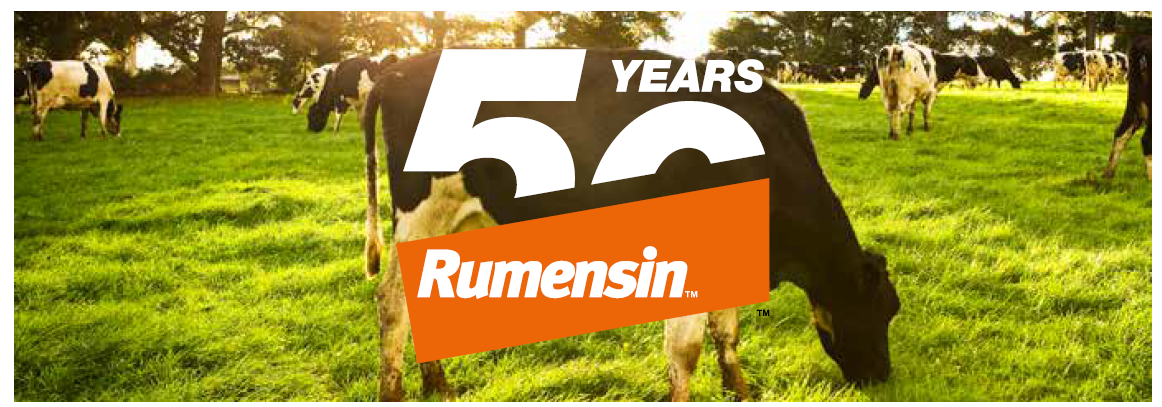
We're so pleased to be celebrating the 50th anniversary of one of our most timeless and popular products, the feed additive, RumensinTM.
Rumensin traces its origins to the early years of Elanco, launched in 1975. This product quickly became the world's leading food additive, and for good reason: its effectiveness.
Rumensin makes more energy available to the animal with every mouthful consumed, regardless of feed intake. Dairy cows can use this extra energy to increase milk production and maintain body condition throughout lactation. Rumensin optimises nutrition and health during cattle's critical life stages and helps prevent the parasitic disease cocccidiosis.
How does Rumensin work?
Rumensin contains monensin, a fermentation product of the naturally occurring bacterium, Streptomyces cinnamonensis.
When added to rations, it alters the rumen microbial population, enabling cattle to digest feed more efficiently and, in turn, extract more energy from every mouthful.
Changes in the rumen microbial population affect the production of volatile fatty acids required for growth and maintenance. Rumensin increases the production of propionic acid, the most efficient of the volatile fatty acids, and decreases production of the less-efficient acetic and butyric acids.
Other benefits of Rumensin
Rumensin also increases the proportion of dietary protein that bypasses rumen fermentation, shifting digestion from the rumen to the intestines.1-3
It also provides several other significant benefits, including reducing metabolic and health challenges such as bloat and ketosis, and aiding in coccidiosis prevention.4
Rumensin for cattle
Rumensin is scientifically proven to improve the efficiency of feed conversion in grain-fed cattle by up to 10.6%, and average daily gain by up to 4.3%, depending on the rate of inclusion in rations.4,5
These benefits have been documented in thousands of scientific papers published worldwide.
One meta-analysis of 161 scientific papers found that Rumensin had a consistent beneficial impact on milk production (+0.7 kg/day), protein yield (+0.016 kg/day), and milk production efficiency (+2.04%).5
Rumensin also significantly increased body weight and condition over the first 30 days of lactation and reduced the incidence of ketosis, displaced abomasums and mastitis.6
Benefits for both beef and dairy cattle
Elanco Senior Brand Manager, Ingrid Gray, says Rumensin remains the industry benchmark for improving the health and performance of beef and dairy cattle. “It’s hard to think of another product that has contributed so much to the livestock industry,” Ingrid says.
“Even after 50 years, monensin is used in more than 90% of beef rations and 50% of dairy rations in Australia. It is also widely used as an additive in supplementary feeds in the extensive beef sector.”
“Quite literally, Rumensin has added billions of dollars to the profitability of beef and dairy production throughout the world.”
Nutrition Service Australia nutritionist, Damien Nankervis, recommends Rumensin as a ‘default’ ingredient in every ration because of its formulation quality, traceability and technical support.
“Rumensin is an incredibly cost-effective input and if you are looking at a cheaper alternative, you have to ask yourself what are you really saving?”, he states.
Damien says an in-depth library of scientific data backs Rumensin. “Elanco has invested heavily in Rumensin over the decades,” he says. “It’s quite amazing – there are quite literally hundreds of scientific papers that support its mode of action, its benefits and its safety for livestock and humans.”
“If you prepared a list of the five things that have had the biggest impact on the Australian beef industry, Rumensin would be one of them. Its ability to improve production efficiency – more kilograms of beef from less kilograms of feed means it’s just as important today as it was 50 years ago.”
Rumensin - 50 years on
Today, Rumensin is used in more than 50 countries, including the USA, Canada, Japan and Australia. Far from being old technology, Rumensin is back in the spotlight for its proven benefits in reducing greenhouse gas emissions.
Studies have shown monensin can reduce methane emission by as much as 30%, depending on the inclusion rate, ration type and feeding duration.7-10
"Animal health is no longer just about helping to produce an abundant source of nutritious, safe and affordable food to feed the world's growing population," Ingrid says.
"It's about helping livestock producers to make the best use of available resources whilst minimising their carbon footprint."
Thanks so much Rumensin! Here's to another 50 years!
Always read and follow label directions.
- Van Maanen, R.W. et al. (1978). Effects of monensin on in vivo rumen propionate production and blood glucose kinetics in cattle. J. Nutr. 108:1002-1007.
- Rumensin premix for dairy cattle. Technical Manual. (1995). Elanco Animal Health. Data on file.
- Duffield, T.F. et al. (2008). A meta-analysis of the impact of monensin in lactating dairy cattle. Part 1: Metabolic effects. J. Dairy Sci. 91:1334-1346.
- Rumensin is registered for improved feed efficiency and as an aid in the control of bloat in feedlot cattle; for improved feed efficiency, weight gain and reproductive performance in heifers; and as an aid in the prevention of coccidiosis caused by Eimeria zuernii and E. bovis.
- Duffield, T., Rabiee, A., Lean, I. (2008) A meta-analysis of the impact of monensin in lactating dairy cattle. Part 2: Production Effects. J. Dairy Sci. 91:1347–1360.
- Duffield, T., Rabiee, A., Lean, I. (2008) A meta-analysis of the impact of monensin in lactating dairy cattle. Part 3: Health and Reproduction J. Dairy Sci. 91:2328–2341.
- Guan, H. et al. (2006) Efficacy of ionophores in cattle diets for mitigation of enteric methane. J. Anim. Sci. 84:1896-1906.
- Grainger, C. & Beauchemin, K.A. (2011). Can enteric methane emissions from ruminants be lowered without lowering their production. Anim. Feed Sci. and Technol. 166-167:308-320.
- Duffield. T.F. et al. (2012) Meta-analysis of the effects of monensin in beef cattle on feed efficiency, body weight gain and dry matter intake. Anim. Sci. 15:4583-4592.
- Vyas, D. et al. (2018) The combined effects of supplementing monensin and 3-nitrooxypropanol on methane emissions, growth rate, and feed conversion efficiency in beef cattle fed high- forage and high-grain diets. J. Anim. Sci. 96:2923-2938.